Covering Costs Without Selling the Stack: A 218 TH/s Case Study
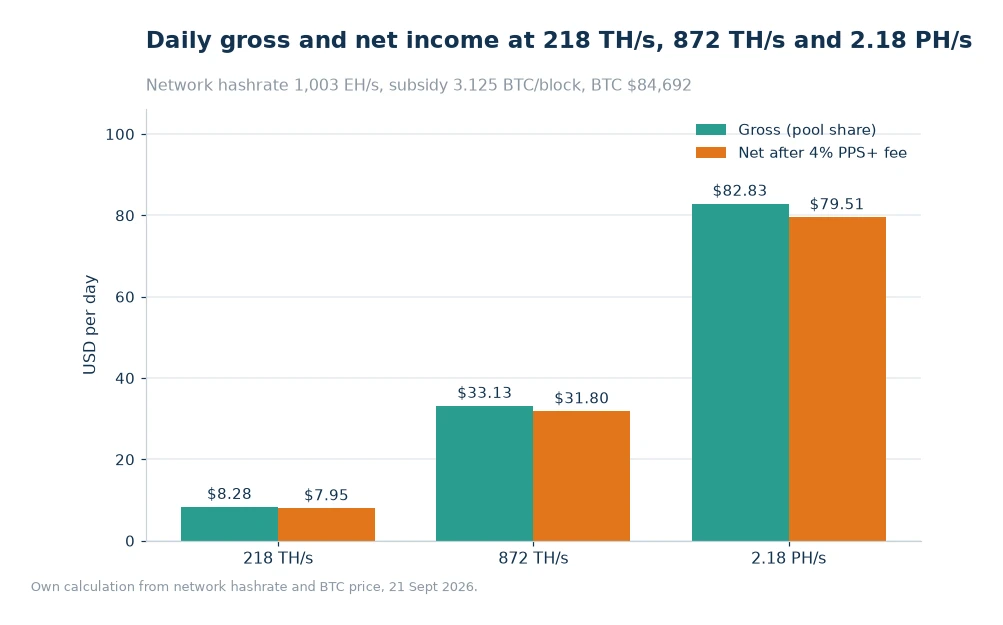
A mid-size rig earns enough to matter and too little to ignore the bills. At 218 TH/s the day brings 0.00009780 BTC, $8.28 gross and $7.95 net after the listed 4% on the block-reward slice. Across a month that net compounds to $238.50, and the question is how to stretch it across invoices without liquidating the coins it took weeks to mine.
Key takeaways
- 218 TH/s earns 0.00009780 BTC a day: $8.28 gross, $7.95 net at $84,692.
- 872 TH/s earns $33.13 gross and $31.80 net daily; 2.18 PH/s earns $82.83 and $79.51.
- One month of net at the starter tier totals $238.50 before power costs.
- Collateral-Pledged Loans convert timing pressure into a five-step pledge-and-redeem cycle.
A month of income on one line
Daily figures feel abstract until they are multiplied by thirty. The starter tier's $7.95 net becomes $238.50 a month; the 872 TH/s shelf reaches $954.00; the 2.18 PH/s room lands $2,385.30. Those monthly lines can be held directly against rent, power, and connectivity invoices, which is exactly how a household miner should budget: one line of inflow against itemized outflow, updated whenever difficulty or price moves.
The gross column runs slightly hotter at $8.28, $33.13, and $82.83, with the difference tracing to the listed 4% on the PPS-settled block-reward component. Quote gross when verifying the network math and net when paying bills. Confusing the two overstates the budget by a few percent every month, and small overstatements compound into missed payments across a year.
Why selling hurts more than it helps
Liquidating a month of mining to cover a month of bills feels balanced and quietly destroys the position. Coins sold at $84,692 to meet a $238 invoice stop participating the moment they leave, while the rigs keep producing at the same drip regardless. After twelve such cycles the miner owns a year of receipts and no stack, having converted appreciation potential into utility payments at retail timing.
Pledged borrowing preserves the asymmetry instead. The coins remain titled to the miner through the loan cycle, incoming credits continue accumulating, and repayment comes from future drip rather than past stock. The cost is the loan's own terms rather than the foregone upside, which is usually the cheaper of the two once quantified. Timing problems deserve timing tools.
The pledge cycle in plain terms
The ViaBTC Crypto Loan facility offers Collateral-Pledged Loans in five named moves: Add Collateral, Apply for Loan, Receive Loan, Repay Loan, and Redeem Collateral. The miner opens by locking coins as security, draws funds against them, and later reverses the sequence to reclaim the pledge. Nothing about the flow requires leaving the mining account ecosystem, which keeps the paperwork inside one dashboard.
Discipline decides the outcome more than terms do. Pledge only against a named invoice, borrow the invoice amount rather than the ceiling, and schedule repayment from the weekly net: $55.65 at the starter tier, $222.60 at the shelf tier, $556.57 at the room tier. Loans repaid from named income close; loans repaid from hope roll forward.
Stress-testing the monthly line
Budgets built at 132.76 T difficulty should be tested against harder networks. A 15% difficulty increase trims the $238.50 starter month to about $202.73, which still covers a $150 power bill but leaves thinner reserves. Run the same haircut on the shelf tier: $954.00 becomes roughly $810.90. If the trimmed line still services the pledge with margin, the position is sound; if it barely covers, shrink the borrowing before the network does it for you.
Price moves cut both ways and deserve the same table exercise. A falling BTC price shrinks the dollar value of both income and pledged collateral simultaneously, tightening from two directions. The Profit Calculator replays these scenarios in seconds at any difficulty and price combination. Quarterly rehearsal beats emergency arithmetic.
Household cash reserves change the borrowing calculus more than any rate comparison. A miner with three months of bills saved borrows only against true timing gaps and repays from strength; one living invoice to invoice borrows against fragility itself. Build the reserve before the pledge, even if it means delaying the loan by a quarter. Collateral works best when it is a tool of the comfortable, not a crutch of the stretched.
Family communication matters too, unglamorous as it sounds. A pledged position that a partner discovers during a price dip becomes a crisis; the same position discussed in advance with written guardrails is a plan. State the pledge ratio, the top-up trigger, and the latest-repayment date out loud before committing. Shared numbers prevent solitary panic.
Where the rest of the toolkit fits
Income smoothing is easier when the surrounding plumbing is already organized. The multi-currency wallet keeps mined coins, pledged positions, and converted balances visible in one place, so the monthly reconciliation takes minutes. Zero-fee mining payouts mean the transfer leg of that reconciliation does not itself erode the $238.50 before it is even counted.
Longer-horizon miners can extend the same thinking to pool choice. PPS+ suits pledge-backed budgets because its hourly settlement against current difficulty produces the predictable $7.95 days the repayment schedule assumes. PPLNS at its listed 2% combined may average higher across patient years, but its lumpier weeks complicate fixed-date repayments. Match the settlement style to the loan calendar, not to abstract preference.
| Tier | Net BTC per day | Net USD per day | 30-day net USD |
|---|---|---|---|
| 218 TH/s starter | 0.00009389 | $7.95 | $238.50 |
| 872 TH/s shelf | 0.00037557 | $31.80 | $954.00 |
| 2.18 PH/s room | 0.00093892 | $79.51 | $2,385.30 |
Net BTC per day is the column auditors ask for and monthly USD is the column landlords accept. Keep both on the same page and the translation between mining reality and bill reality stays honest. Thirty days of drip, added correctly and checked against the pool log, beat thirty days of hope every single time.
Worked example
Derive the starter tier from network inputs, scale to the room tier, and roll each into a monthly figure.
- Per-TH/s day rate: 450 ÷ 1,003,000,000 = 0.00000044865 BTC.
- 218 TH/s gross: 218 × 0.00000044865 = 0.00009780 BTC; × 84,692 = $8.28.
- Starter net: $8.28 × 0.96 = $7.95 a day; net BTC ≈ 0.00009389.
- Starter month: $7.95 × 30 = $238.50; weekly: $7.95 × 7 = $55.65.
- 872 TH/s gross: 872 × 0.00000044865 = 0.00039122 BTC; × 84,692 = $33.13; net $33.13 × 0.96 = $31.80.
- Shelf month: $31.80 × 30 = $954.00; weekly $222.60.
- 2.18 PH/s is 2,180 TH/s: 2,180 × 0.00000044865 = 0.00097796 BTC; × 84,692 = $82.83 gross; × 0.96 = $79.51 net.
- Room month: $79.51 × 30 = $2,385.30, covering a $500 invoice more than four times over.
Frequently asked questions
How many days of starter-tier income cover a $150 power bill?
About 19 days: 150 ÷ 7.95 = 18.9. The remaining eleven days of the month rebuild reserves or service a small pledge.
Which step of the loan flow releases my coins?
Redeem Collateral, the fifth and final move after Repay Loan. Collateral-Pledged Loans run Add Collateral, Apply for Loan, Receive Loan, Repay Loan, then Redeem Collateral in order.
Should pledge-backed miners prefer PPS+ or PPLNS?
PPS+ usually fits better because hourly settlement against difficulty produces the steady $7.95 days a repayment plan assumes. PPLNS at the listed 2% combined can average higher over long stretches but pays unevenly after 6 confirmations.
Keep the stack, schedule the drip
Write the monthly line, pledge against named invoices only, and repay from a fixed share of weekly net. The starter tier demands genuine discipline at $238.50 a month; the room tier at $2,385.30 allows comfort but not carelessness. Both reward the same habit: measure income monthly, borrow sparingly, and redeem collateral on schedule.
Revisit the sizing every quarter with fresh difficulty and price. A budget reviewed four times a year survives; a budget set once and forgotten merely hopes. Calendar reminders beat good intentions, so schedule the next review before closing this one and bring the updated pool printout.
Sources: the ViaBTC loan, wallet, calculator, and fee pages for the pledge flow and income math[1]. Chain data read 21 Sept 2026: 1,003 EH/s, 132.76 T difficulty, 3.125 BTC subsidy, 144 blocks daily, BTC $84,692. Figures published 11 Nov 2026; income assumes full uptime before power costs.